The history of the house
Lustigbacken 3 is housed in the Hansén house, just west of the church in the Gammelstad Church Town World Heritage Site. Here is what we know about its history, and what we are still trying to find out.
The house
The main house has two storeys, a log frame and horizontal weatherboarding. In 2011 Luleå Municipality judged that it was probably built in the 18th century and that it took on its present appearance around 1900.
Norrbottens museum holds a photograph from 1901 taken at the Hansén house. It shows what is thought to be Albert Nordberg's first confirmation class in the parish, with the house in the background. Nordberg was then an assistant vicar and later became rural dean.
In the oldest pictures the house is painted a dark colour. From the 1920s onwards it appears light.
Gammeläng
The farm dates back to the early 1700s, long before it was given its present boundaries on the map. It was only formed as a property of its own in 1870, as Gammeläng 1:1, in a land survey concerning meadowland that had been drained by ditching. The land had previously belonged to the church's glebe farms, which the parish priest and other church officials farmed as part of their pay.
The name Gammeläng simply means “the old meadow”. Since 1989 the property has been registered as Gammelstaden 29:1.
The Hansén family
The house is named after David Hansén (1880–1957). Born in Skogså in Överluleå, he came to Gammelstad in 1898, aged 17, to work as a shop assistant for a tannery owner and shoe merchant. In 1910 he married Göta Sundberg (1883–1965), daughter of the schoolteacher and church organist Simon Petter Sundberg of Gammelstad. The same year he became a wholesale merchant and head of the firm N. J. Wikström & Co. The couple's four children were born in Gammelstad between 1911 and 1920.
Hansén chaired the Nederluleå municipal meeting from 1915 to 1919 and the municipal council from 1919 to 1930. He sat in the upper house of the Swedish Parliament in 1919–1920 and 1928–1938, where he was at first known as “Hansén i Gammelstad”. He was Minister of Trade from 1930 to 1932 and Governor of Norrbotten County from 1937 to 1947. As governor he was among those leading the reception of some 50,000 evacuees from northern Finland in 1944, and he was one of the driving forces behind the Norrbotten steelworks in Luleå.
Norrbottens museum holds photographs of “Hansén's villa” and “David Hansén's home in Gammelstad” from the 1920s, 30s and 40s. Later the house became the family's summer residence. The museum also holds a puppet theatre that was kept at the summer residence and that the children probably played with.
The farm through the years
The church town from the air
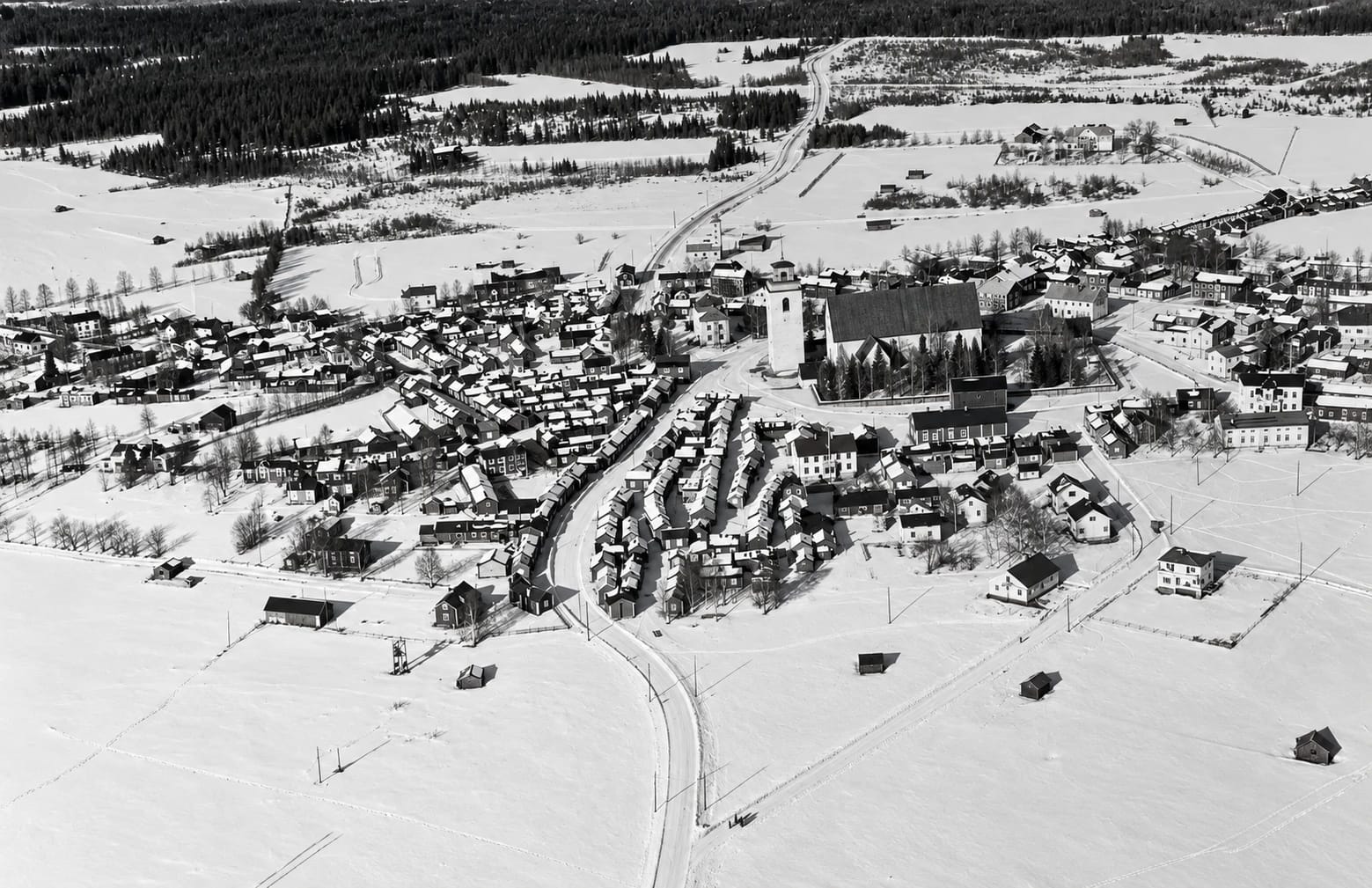
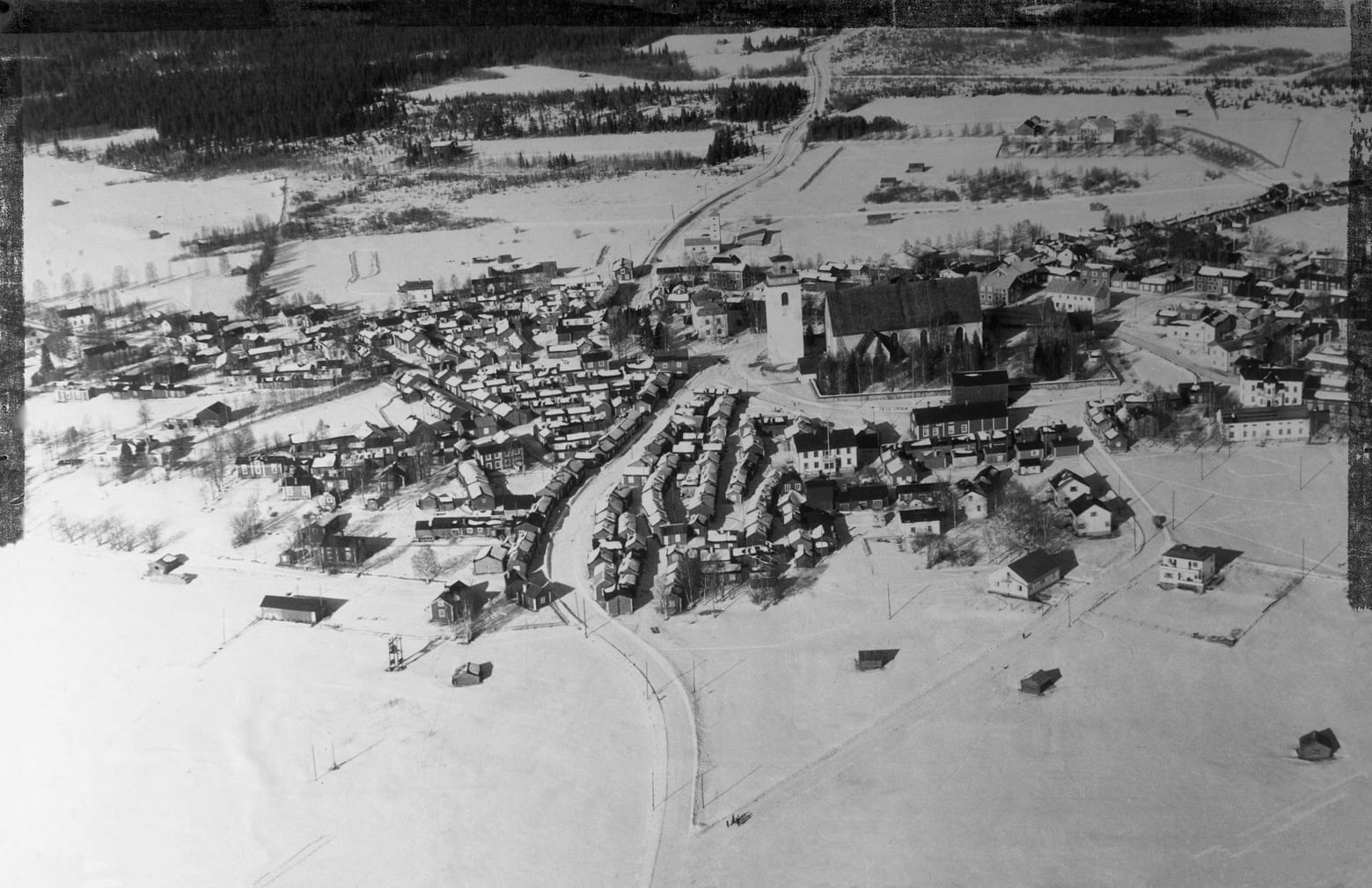 OriginalSharpened with AI
The tennis court
The house had its own tennis court. It can be clearly seen in Adolf Hjort's photograph of David Hansén's home from the 1940s: the flat, light area on the lawn in front of the house.
It is said to have been one of the first tennis courts in Norrbotten. We do not yet know when it was laid out. The oldest tennis photograph in the collections of Norrbottens museum dates from around 1920 and shows two boys playing in the yard of the vicarage here in Gammelstad. The town of Luleå built a wooden tennis court at Gültzauudden in 1922.
Do you know when the tennis court was laid out, or do you have old photographs of the house? We would love to hear from you.
A group home
Luleå Municipality bought the house in 1988 and used it as a group home. In the early 1990s it was converted, and it then held five small flats and a staff room. The drawings for the conversion show the ground floor as it was before: a family home with a parlour, a living room, two bedrooms, a dining room and a kitchen. The municipality sold the house in 2011. Since then it has been a private home and has been renovated in several stages.
The storehouse
The farm has a large two-storey log storehouse (härbre) with a gallery and a projecting loft. It was restored in 2015 with a state grant and with the involvement of a building conservator. The storehouse was lifted and given a new hand-hewn base, built with the old one as a model.
The storehouse measures roughly six by eight metres, with vertical boarding painted in traditional red slamfärg. Inside stood two old grain bins, which were removed during the restoration.
Below ground
The whole church village is an ancient monument, so any groundwork is checked by archaeologists. When district heating was laid in 2002, Norrbottens museum followed the trench up across the plot. Beneath the turf was a layer of stones, brick, glass, porcelain and animal bones, laid down as fill in the 19th century. Below that was an older, disturbed occupation layer with crushed brick, clay pipe stems and burnt bone from the 18th and 19th centuries.
A protected heritage site
Gammelstad Church Town became a UNESCO World Heritage Site in 1996. Under the local plan for the church village, the house and the storehouse are classed as buildings of cultural and historical value that must not be demolished or altered in character.
Today
Since 2023 the house has been owned by us, Agneta Hedenström and Peter Parnes. At New Year 2024/25 we opened Lustigbacken 3, with bean-to-bar chocolate and a small café.
Timeline
- Early 1700s The farm is established and the house built (probably)
- 1870 The property Gammeläng 1:1 is formed
- c. 1900 The house takes on its present appearance. The oldest known photographs of the farm.
- 1920s–1940s Home of the Hansén family, later their summer residence. The tennis court appears in a photograph from the 1940s.
- 1988–2011 Municipal group home. The house is converted in the early 1990s.
- 2002 Archaeological check when district heating is laid across the plot
- 2015 The storehouse is restored
- 2024 Lustigbacken 3 opens
Sources
- Luleå Municipality: property description for Gammelstaden 29:1, the Hansén house in Kyrkbyn (2011), with land register extract and local plan.
- Lantmäteriet, Historical maps: file 25-NLÅ-423 (1869–1870).
- Svenskt biografiskt lexikon (Swedish Biographical Dictionary): “David Hansén”, vol. 18, by Arvid Moberg.
- Norrbottens museum: photographs 1997:841, 1978:304:5, 1975:1466:2, 1975:2094:4, 1975:2095:3, 1990:361, 2005:101 and 1986:1425, and object 024839.
- Nederluleå local history society, Bygdeband (hembygd.se), including postcards from the society's collection.
- Bebyggelse i Norr: conservation report on the restoration of the storehouse, 2015.
- Luleå City Archives: images 2018001100003 (aerial photograph, 1940s) and 2021000400316 (1963).
- Lindgren, Å. 2005. Fjärran fjärrvärmen. Arkeologisk förundersökning Gammelstad, Raä 330. Norrbottens museum, file 2002/0212.
- Lantmäteriet: Economic Map 1950, sheet 24L 9h Gammelstad.
- MAF Arkitektkontor: survey drawing, Gammeläng 1:1, conversion (job number 90091).